

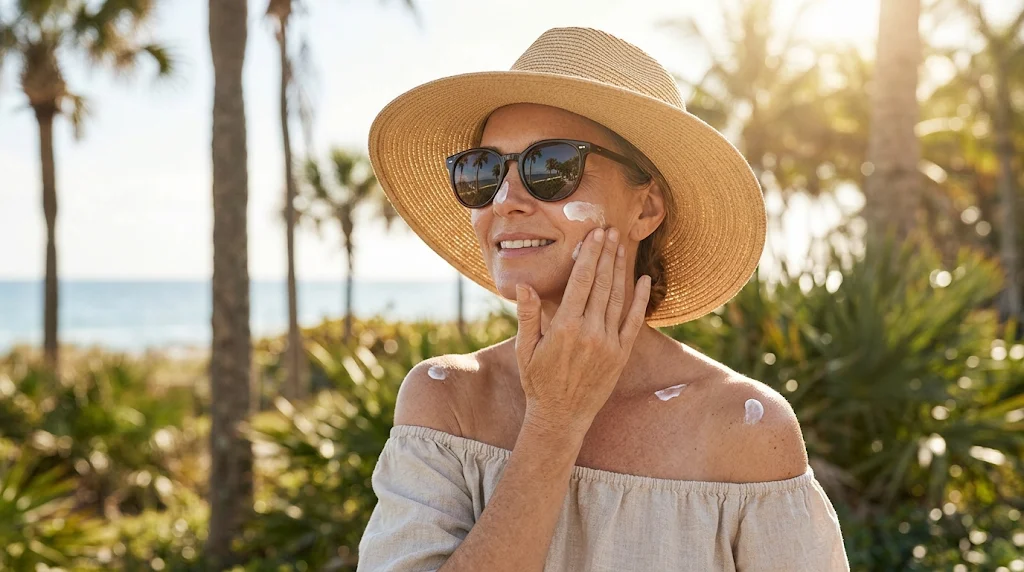
Living in Palm Beach County means sunshine almost every day of the year, and that is one of the best parts of calling South Florida home. It also means your skin works harder than skin in most other parts of the country. At Dermatology & Cutaneous Surgery Institute (DCSI), we see sun-damaged skin in patients of every age, often years before they expect to notice signs of aging. Understanding how the sun affects your skin can help you protect it, whether you spend your days at the beach, on the golf course, or just running errands around Wellington or Delray Beach.
Understanding Sun-Damaged Skin in a Year-Round Sun Climate
Most people think of skin aging as something that simply happens over time. In reality, a large share of what we think of as aging skin, including wrinkles, rough texture, and uneven tone, comes from cumulative sun exposure rather than the passage of time alone. Dermatologists call this process photoaging, which means aging caused by ultraviolet (UV) light rather than by age alone.[1] Because South Florida sees strong UV levels in every season, residents build up this kind of sun exposure faster than people in cooler, cloudier climates.
Sun-damaged skin can show up as fine lines, dryness, a leathery texture, or brown patches known as sun spots on skin.[1] The sun's ultraviolet rays also break down collagen and elastin, the fibers that keep skin firm and stretchy.[1] Over years of exposure, this breakdown is what makes photoaging look different from the thinner, more fragile skin that comes with age on its own.
How Sun Spots on Skin and Other Changes Develop
Sun spots on skin, sometimes called age spots, are flat brown marks that form after years of UV exposure, most often on the face, hands, arms, and chest.[1] They tend to show up earlier and in greater numbers in places like Wellington and Delray Beach, where strong sun exposure is a year-round reality rather than a summer event. Wearing a wide-brimmed hat and using a broad-spectrum sunscreen that blocks both UVA and UVB rays can help prevent new sun spots from forming.[1]
Not every skin change from the sun is harmless, though. Because ultraviolet exposure is also a leading cause of skin cancer, keeping track of changes to your skin matters as much as treating the cosmetic signs of sun-damaged skin.[2,3] Our skin cancer screening visits give our Delray Beach and Wellington patients a chance to catch concerning changes early.
Everyday Sun Protection Habits for Palm Beach County
You do not need to avoid the outdoors to protect your skin. A few daily habits make a real difference against sun-damaged skin over time. The Centers for Disease Control and Prevention recommends staying mindful during the hours when UV rays are strongest, generally late morning through mid-afternoon, and seeking shade whenever your shadow looks shorter than you are.[5]
Applying a broad-spectrum sunscreen every morning, even on cloudy days, is one of the simplest ways to slow photoaging. Dermatologists generally recommend a broad-spectrum sunscreen with SPF 30 or higher.[3] Reapply every two hours, and more often if you are swimming or sweating.[2,3] Pairing sunscreen with a wide-brimmed hat, UV-blocking sunglasses, and lightweight long sleeves adds another layer of protection for days spent outside.
When Sun-Damaged Skin Needs a Dermatologist's Attention
Age spots and mild sun-damaged skin are usually harmless, but some changes deserve a closer look. A mole or spot that is asymmetrical, has an irregular border, shows more than one color, is larger than a pencil eraser, or has changed recently in size or shape should be checked by a dermatologist.[1] Antioxidants for skin, found in a balanced diet and in some skincare products, may help support the skin's natural defenses, though they are not a substitute for daily sun protection.
If you are noticing new sun spots on your skin, rough patches that will not go away, or anything that concerns you, our team at DCSI can help you tell the difference between ordinary sun-damaged skin and something that needs treatment. We also offer options to improve the look of existing sun damage for patients who want a more even, refreshed complexion. Learn more about our board-certified dermatologists and how we approach sun-damaged skin at both our Wellington and Delray Beach offices.
Sun-damaged skin develops gradually, which makes it easy to overlook until the signs become more noticeable. Protecting your skin today, with sunscreen, shade, and regular dermatologist visits, is the most effective way to slow photoaging and catch anything serious early. Schedule an appointment with our Wellington or Delray Beach team to talk about a sun protection plan that fits your lifestyle.
Frequently Asked Questions
What is photoaging and how is it different from normal skin aging?
Photoaging is skin aging caused by cumulative sun exposure, such as wrinkles, rough texture, and sun spots on skin. Normal, or chronological, aging happens from the passage of time alone and causes thinner, drier skin. Photoaging is largely preventable with sun protection, while chronological aging is not.
How often should I reapply sunscreen in South Florida's climate?
Reapply broad-spectrum sunscreen about every two hours, and immediately after swimming, sweating, or toweling off. South Florida's strong year-round UV levels mean sunscreen should be part of your daily routine, not just a beach-day habit.
Can sun-damaged skin be reversed, or only prevented?
Some signs of sun-damaged skin, like fine lines and uneven tone, can be softened with professional treatments, while prevention remains the most reliable way to protect your skin long term. A dermatologist can recommend options based on your specific skin and goals.
What is the difference between a sunspot and a sign of skin cancer?
A typical sunspot is flat, evenly colored, and stable in size. A spot that changes shape, develops uneven color or borders, or grows larger over time should be evaluated by a dermatologist, since these can be early signs of skin cancer.
Sources
- National Institute on Aging. Skin care and aging. https://www.nia.nih.gov/health/skin-care/skin-care-and-aging. Accessed November 2026.
- Centers for Disease Control and Prevention. Sun safety facts. https://www.cdc.gov/skin-cancer/sun-safety/index.html. Accessed November 2026.
- American Academy of Dermatology. Practice safe sun. https://www.aad.org/public/everyday-care/sun-protection/shade-clothing-sunscreen/practice-safe-sun. Accessed November 2026.
- American Academy of Dermatology. 11 ways to reduce premature skin aging. https://www.aad.org/public/everyday-care/skin-care-secrets/anti-aging/reduce-premature-aging-skin. Accessed November 2026.
- Environmental Protection Agency. UV index scale. https://www.epa.gov/sunsafety/uv-index-scale-0. Accessed November 2026.