
Taking care of your health is always a smart move, but visiting a doctor's office for a new checkup can feel unsettling, especially if you are not sure what to expect. You might have several questions running through your mind. If you're getting ready for your first full-body skin exam, you are probably wondering what will happen. This simple screening is usually quick, comfortable, and noninvasive. In fact, it is one of the best ways to support long-term skin health.
At the Dermatology & Cutaneous Surgery Institute (DCSI), our experienced team focuses on preventative dermatology. This means we help identify potential skin concerns early, before they become more serious. We have offices in Wellington and Delray Beach and serve patients across Palm Beach County. Dr. Mounir M. Wassef and our clinical staff will prioritize your comfort throughout the visit.
Why a First Full-Body Skin Exam Is Essential in South Florida
Living in our sunny state means your skin is exposed to strong sunlight throughout the year. The sun stays strong all year long, so protecting your skin is a daily responsibility. The U.S. Surgeon General has warned about the importance of skin cancer prevention, and getting South Florida skin checks is important for adults.¹
Maybe you drive to work with the windows down every morning. Or, perhaps you relax on the beach near Boynton Beach. Over time, daily sun exposure can add up, but an annual skin check can help us spot small skin changes early. Booking a visit gives us a clear baseline for future comparison. You can also learn healthy daily habits in our guide to avoid skin cancer.
Simple Steps for Your Appointment in Delray Beach or Wellington
Many people wonder what to expect at the dermatologist's office. Dermatology appointment preparation is simple. First, we ask that you come to the office without nail polish or makeup. If you have any on, we’ll have you remove it. This way, our doctor can better examine your bare skin and nails. You can also check your skin at home before the visit. Simply write down any spots that look different to you, and bring that list with you to show us when you get to the office. You should also write down any medicines you currently take and share this list with us.
Our team wants your visit to be as smooth as possible. If you choose our Wellington dermatology clinic, we proudly treat patients from Loxahatchee, and our dermatologist in Delray Beach is close to Lake Worth.
We want you to feel comfortable during your appointment. To save extra time, please fill out your forms on our new patient page before you walk in. This can help reduce your wait time.
The Step-By-Step Process Inside the Exam Room
Once you step into the private room, things are relatively straightforward. A professional skin exam is a careful visual review of your skin. First, we'll give you a cloth medical gown. Then, our nurse will step out so you can change in private. Next, the doctor will do a complete head-to-toe skin check. The dermatologist may examine your scalp, behind your ears, and between your toes. The CDC says these simple visual checks can help identify suspicious areas that may otherwise be missed.²
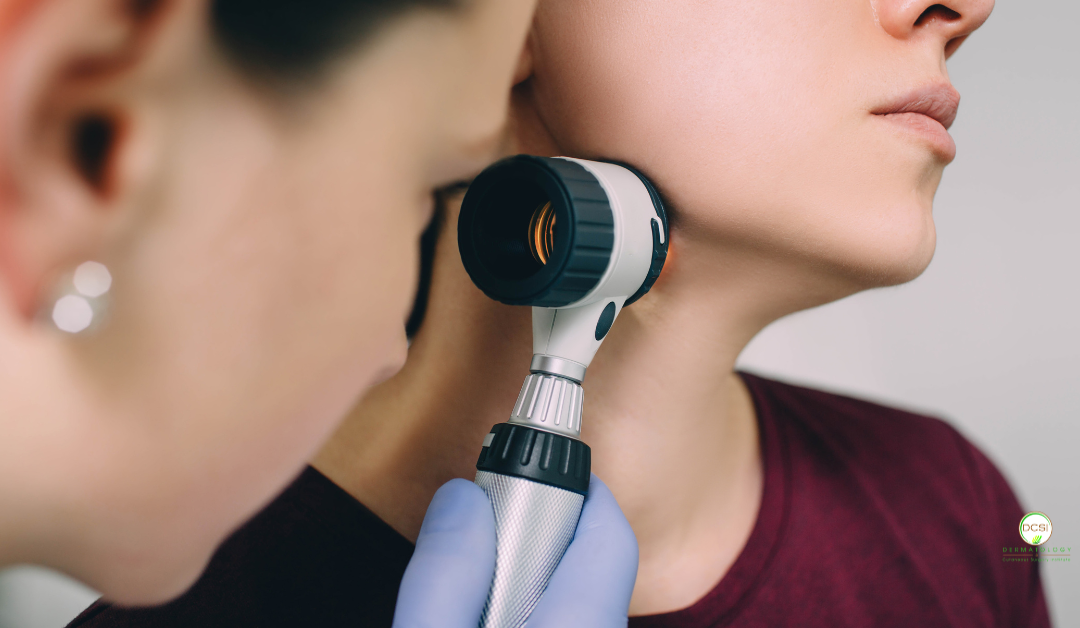
When checking moles for skin cancer, we use a lighted magnification tool called a dermatoscope. It helps the doctor see skin features that may not be visible to the naked eye. If we spot anything unusual, we'll tell you during the exam. Your first full-body skin exam is not painful, and you won't feel any poking or prodding during the visual screening.
The entire process is quite fast, usually taking about 10 to 15 minutes. You can read about the skin conditions we treat to see some of the concerns we evaluate. Afterward, you will get dressed and can ask any remaining questions you have. We are happy to answer questions because we want you to understand your skin and your care plan. Getting your first full-body skin exam can provide you with valuable peace of mind.
Spotting the Early Warning Signs on Your Skin
Patient education is a significant part of our job. During your visit, we'll show you the early signs of skin cancer.
We use the ABCDE method to check dark spots.
- A stands for asymmetry. This means one half of the spot doesn't match the other.
- B is for border. We look for jagged edges.
- C represents color. We check for odd colors mixed in.
- D is for diameter. We measure to see if the spot is bigger than a pencil eraser.
- E stands for evolving. This means checking to see if the spot is growing.³,⁴
We do a careful check for suspicious moles to make sure your freckles are evaluated properly. However, if we do find a concerning spot, please don't worry. Dr. Wassef has experience with Mohs surgery. This is a highly precise way to remove certain skin cancers layer by layer, and it saves as much healthy skin as possible.
Our office handles many medical dermatology services, from skin evaluations to advanced care. We will explain everything in simple terms to ensure you never feel confused about your care plan.
Healthy habits start early in life. We invite parents to read our pediatric skin guide. Kids need sun protection just as much as adults do, and a child's skin is very sensitive. Building good routines early can help support long-term skin health.
Having a first full-body skin exam may also be helpful for older teens. We treat patients of all ages with the same gentle care.
Put Your Health First With Your Local Experts
Catching a concerning spot early can make a meaningful difference, and peace of mind is valuable. Whether you need a trusted Delray Beach dermatologist or a skin cancer screening in Wellington, we are here for you.
We treat every patient with attentive, personalized care. You can also see Dr. Wassef's community involvement on our news and press updates page.
Don't wait to take care of yourself. Taking action today can help protect your skin health. Booking your first full-body skin exam is simple. Reach out to Dr. Wassef and the DCSI team through our appointment request portal. Our front desk team will help you pick a convenient appointment time.
We look forward to providing supportive, professional care. You are in good hands with us.
Sources
- U.S. Department of Health and Human Services. The Surgeon General's Call to Action to Prevent Skin Cancer. Washington, DC: Office of the Surgeon General; 2014. Accessed May 2026. https://www.hhs.gov/surgeongeneral/reports-and-publications/skin-cancer/executive-summary/index.html
- Centers for Disease Control and Prevention. What Is Skin Cancer Screening? Accessed May 2026. https://www.cdc.gov/cancer/prevention/screening.html
- Centers for Disease Control and Prevention. What Are the Symptoms of Skin Cancer? Accessed May 2026. https://www.cdc.gov/skin-cancer/symptoms/index.html
- National Cancer Institute. Skin Cancer Screening (PDQ®)–Patient Version. Accessed May 2026. https://www.cancer.gov/types/skin/patient/skin-screening-pdq