
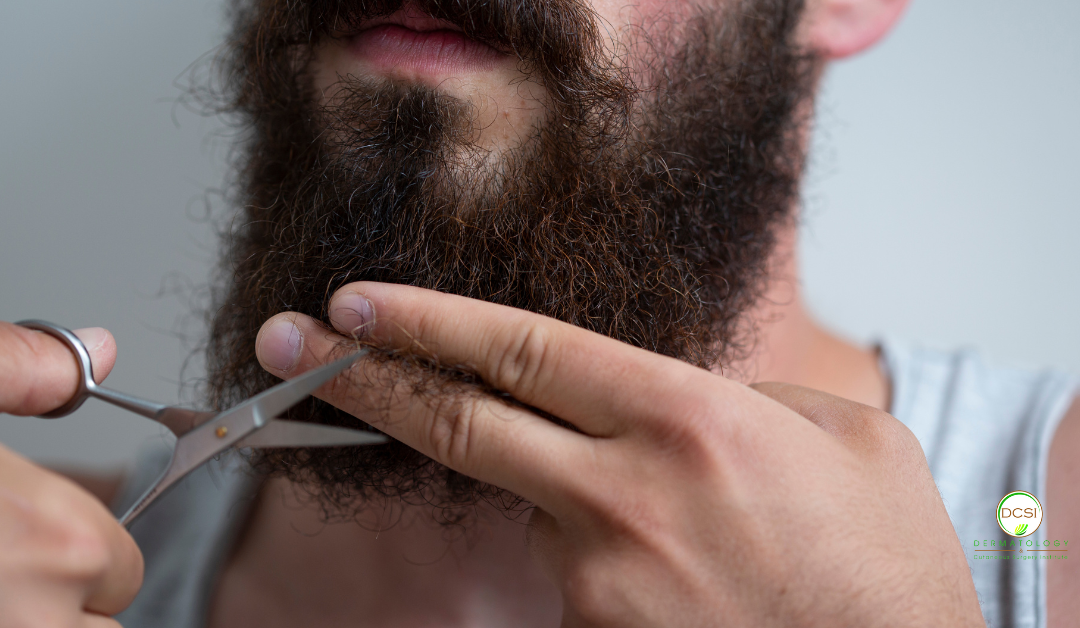
Beard care often focuses on the hair itself, but the skin underneath requires just as much attention. At Dermatology & Cutaneous Surgery Institute (DCSI), Dr. Mounir M. Wassef and our team frequently see patients struggling with facial itchiness, flaking, and irritation that does not resolve with standard grooming products. While many assume they are simply dealing with dry skin under beard growth, the reality is often more complex. Without a proper diagnosis, simply applying more beard oil can sometimes make the problem worse rather than better.
Understanding the Root Cause: Dryness vs. Dermatitis
The first step in treating that annoying itch is determining exactly what is happening beneath the hair. While the symptoms often look the same, white flakes on your collar or a tight sensation on your jaw, the biological causes differ significantly.
True dry skin lacks water and oil. It occurs when your skin barrier is compromised by harsh soaps or environmental factors. However, what many men call beard dandruff is frequently a condition known as seborrheic dermatitis. This is an inflammatory reaction to Malassezia, a yeast that naturally lives on everyone's skin.¹
If you have seborrheic dermatitis, your skin isn't dry. It is actually producing too much oil, which the yeast feeds on. This results in greasy, yellowish flakes and red, inflamed patches. This distinction is vital because treating a fungal condition with heavy oils can trap heat and feed the yeast, exacerbating the inflammation. For persistent flaking that does not respond to moisturizers, we recommend checking our resources on scalp conditions, which often share similar pathology to beard issues.
Environmental Triggers for Dry Skin Under the Beard
Regardless of the time of year, your environment plays a massive role in skin health. Air conditioning, low humidity, and hot showers can all strip away the natural sebum that protects your face. When you wash your face with hot water, you might feel clean, but you are likely leaving the skin beneath your beard vulnerable and tight.
This combination of stripping the skin barrier and environmental exposure creates the perfect storm for dry skin under beard areas. If you already have an underlying sensitivity, daily habits like aggressive towel drying or using alcohol-based aftershaves will only amplify the irritation.
Distinguishing Beard Dandruff From Psoriasis and Eczema
Sometimes the irritation is a sign of a chronic autoimmune condition. Psoriasis, for instance, can manifest on the face as thick, silvery scales on top of raised red plaques. It is distinctly different from simple dryness and requires a targeted medical approach. If you notice well-defined patches that bleed when scratched or extend beyond the beard line, you may need to explore professional psoriasis treatment options to manage the flare-ups effectively.
When Pimples Aren’t Acne: Folliculitis and Ingrown Hairs
Another common complaint we treat at our Wellington and Delray Beach offices is the appearance of painful red bumps. Patients often mistake this for adult acne, but when it occurs strictly in the beard area, it is frequently folliculitis. This infection of the hair follicle can be caused by bacteria or fungi.²
For men with curly or coarse hair, the issue might be pseudofolliculitis barbae, commonly known as razor bumps or ingrown hairs.³ When a hair is cut short and curls back into the skin, the body treats the ingrown hair as a foreign object, leading to inflammation. While over-the-counter washes help, persistent cases often require medical intervention. If you are struggling with bumps that look like acne but do not respond to standard cleansers, reviewing our acne treatment protocols or discussing laser options with us is a smart next step.
A Dermatologist-Approved Routine for Beard Care
Managing the health of your beard requires a routine that addresses both the hair and the skin underneath. We suggest a three-step approach to keep the dry skin under the beard areas healthy and hydrated.
First, stop using bar soap on your face. It is often too harsh and has a high pH that disrupts your skin barrier. Switch to a gentle, sulfate-free cleanser. Second, exfoliation is key. Using a boar bristle brush can help lift the hairs away from the skin, preventing ingrown hairs while mechanically removing dead skin cells before they flake off.
Finally, moisturize the skin, not just the hair. If you have true dry skin, look for products containing ceramides or hyaluronic acid. If you are prone to acne or folliculitis, avoid heavy coconut oils and opt for non-comedogenic lotions.
Frequently Asked Questions
Why do I still have beard dandruff even after using beard oil?
If your dandruff is actually seborrheic dermatitis, oils might be feeding the yeast that causes the flakes. You may need a medicated antifungal shampoo containing ketoconazole or zinc pyrithione instead of cosmetic oils.⁴
What is the difference between dry skin and beard fungus?
Dry skin usually produces small, white flakes and feels tight. Fungal conditions (dermatitis) typically produce greasy, yellow flakes accompanied by red, itchy patches.
How can I treat ingrown hairs (razor bumps) under my beard?
Avoid shaving closely. Use a single-blade razor and shave with the grain. If the problem persists, laser hair removal is often the most effective permanent solution.
Can stress or the environment cause beard hair loss?
Yes, stress can trigger conditions like alopecia areata, where the immune system attacks hair follicles, causing circular bald patches. While environmental dryness causes itch, it rarely causes patchiness. We recommend visiting our page on hair loss treatment to understand the symptoms.
Achieving Lasting Relief for Beard Irritation
You do not have to live with an itchy, flaking face. Whether you are dealing with common dry skin under beard growth or a medical condition like dermatitis, the correct diagnosis is the key to relief.
If home remedies aren't working, it is time to see a professional. Contact Dr. Mounir M. Wassef and the DCSI team today to restore your skin's health. We are currently accepting new patients at both of our South Florida locations. You can schedule an appointment online and get started on a treatment plan that works.
Sources
- American Academy of Dermatology. A dermatologist’s top tips for a healthy beard. aad.org. Accessed January 2026. https://www.aad.org/public/everyday-care/skin-care-secrets/face/healthy-beard
- Cleveland Clinic. Folliculitis: symptoms, causes, tests & treatment. Cleveland Clinic. Accessed January 2026. https://my.clevelandclinic.org/health/diseases/14404-folliculitis
- Ogunbiyi A. Pseudofolliculitis barbae; current treatment options. Clin Cosmet Investig Dermatol. 2019;12:241-247. Accessed January 2026. https://pmc.ncbi.nlm.nih.gov/articles/PMC6585396/
- MedlinePlus. Folliculitis. MedlinePlus. Accessed January 2026. https://medlineplus.gov/ency/article/000963.htm